ISO 9001 vs. ISO 14001 vs. ISO 45001: Which Stone Processing Certification Matters Most for Your Project?
ISO 9001 vs. ISO 14001 vs. ISO 45001: Which Stone Processing Certification Matters Most for Your Project?
The short answer: ISO 9001 decides whether the stone arrives to the thickness, edge profile and surface finish you approved. ISO 45001 becomes the non-negotiable certificate when fabrication, lifting and handling carry real injury risk — exterior wall work is the clearest example. ISO 14001 moves to the front when the project location, or the client's procurement policy, enforces controls on dust, slurry, water and waste. All three matter, but the priority order changes with the application, not with the supplier's marketing.
This guide compares the three ISO management system certificates held by GLOBALSTONE's stone processing operation (Product ID 3642, models YL-001 and YL-002) — quality, environmental and occupational health and safety — against the two project types most buyers bring to a stone factory: interior home renovation and exterior wall work. All three certificates were issued by Huaxinjintai, and the certificate numbers appear in the comparison table later in this article so you can match them against the documents you actually receive.
Why "Are You Certified?" Is the Wrong Question
Ask a stone factory whether it is certified and almost every answer is yes. The useful question is which certificate, issued against which scope, by which body — because ISO 9001, ISO 14001 and ISO 45001 are three separate management systems, audited against three separate sets of requirements, and they are not interchangeable.
- ISO 9001 addresses the quality management system: documented procedures, process control, traceability and corrective action. It is the certificate that governs repeatability of product output.
- ISO 14001 addresses the environmental management system: how the operation identifies, controls and records its environmental impact.
- ISO 45001 addresses occupational health and safety: how worker hazards are identified, controlled and monitored.
The failure modes are just as separate. A quality-system failure shows up as a shipment whose thickness, edge profile or surface finish does not match the approved sample. An environmental failure shows up in a client audit, a permit condition or a local enforcement issue. A safety failure shows up in fabrication and handling risk — the kind of risk that becomes relevant the moment stone is cut, lifted and fixed under site conditions.
There is a second trap: ISO certificates are issued against a defined scope and a named legal entity. A certificate held by one production unit does not automatically describe every product a trading office sells. Before you treat a certificate as evidence, confirm that the entity name on the certificate matches the supplier named on your purchase order, and that the product categories on the certificate match the categories you are buying. GLOBALSTONE is the brand under which Fujian Nan'an Yinglei Stone Co., Ltd., established in 2010 and based at Daying Industrial Zone, Shuitou Town, Nan'an City, Fujian, China, supplies stone processing services for marble and granite.
Certification as a Screening Filter in a Growing Stone Market
Stone buying has become more international, and certification has become the first filter in supplier selection. Custom Market Insights values the global stone processing market at USD 7.5 billion in 2024 and projects USD 13.6 billion by 2033, a 5.5% CAGR. Fortune Business Insights reports that Asia-Pacific held 38.61% of the stone processing machine market in 2025, while the Observatory of Economic Complexity records China as the top exporter of stone processing machines in 2024 with an export value of USD 6.43 billion. On the material side, Imperial Stone Group reports granite holding the largest share of the natural stone market at 35–40%, with marble at 20–25%.
Two developments explain why certification questions have become more specific. First, ISO/TC 327 is developing global standards for natural stone nomenclature, definitions and test methods, with the aim of unifying international trade — the direction of travel is toward more documented, comparable stone specifications. Second, buyers in regulated markets already work with equipment-level standards: EN 12418:2021 is the established safety standard for masonry and stone cutting-off machines within the European market, published by CEN. A buyer who has to satisfy that kind of framework on the machinery side naturally asks equivalent questions about the factory's own management systems.
The practical consequence is straightforward. Screening suppliers by "ISO certified" is efficient only if you know which certificate answers your project's dominant risk. Otherwise you are comparing three different answers to three different questions.
The Three Certificates GLOBALSTONE Holds — and What Each One Actually Covers
GLOBALSTONE's stone processing operation holds three management system certificates, all issued by Huaxinjintai. Each one governs a different part of the production reality behind an order.
ISO 9001 — Quality Management (Certificate 43126Q00163R000)
ISO 9001 is the certificate that determines whether the stone you approved is the stone you receive. It governs documented process control, traceability and corrective action — the mechanisms that make an approved sample repeatable across a production run rather than a one-off demonstration.
For the stone processing service (models YL-001 and YL-002, Product ID 3642), the quality system sits behind a defined specification: thickness options of 1.8 cm, 2.0 cm and 3.0 cm; surface treatments including polished, honed, flamed, bush hammered, antique, acid washed and tumbled; and processing and shaping routes that cover straight edge, small radius edge, full round edge, flat molding, curved slab, irregular shape and curbstone. The company also offers a customized thickness service from 2 cm to 3 cm with minimal deviation. Each of those options is a control point, and a quality management system is what keeps them consistent from one order to the next.
The slab and finished-product side of the business follows the same logic. Models YL-123 and YL-1234 are produced from natural marble, natural granite or engineered stone, in slab sizes of 2400×1200 mm and 3000×1500 mm, with thickness options of 15 mm, 18 mm, 20 mm and 30 mm, and finishes including polished, honed, flamed and brushed. Processing for anomalous panels and furniture is also offered. These products are intended for construction, interior design, architecture, decoration, hotel projects and commercial buildings.
ISO 14001 — Environmental Management (Certificate 43126E00141R010)
ISO 14001 governs how a stone processing operation identifies, controls and records its environmental impact. In practice, that means how dust, slurry, water, waste and noise are managed as part of the production process rather than as an afterthought.
This certificate becomes commercially relevant in two situations. The first is a project whose procurement conditions include environmental criteria, where the buyer's client or main contractor expects documented environmental management from the supply chain. The second is export into markets with stricter environmental enforcement, where an undocumented processing operation is a supply risk. What ISO 14001 does not do is certify the environmental performance of an individual slab; it describes the management system of the certified operation.
ISO 45001 — Occupational Health and Safety (Certificate 43126S00142R010)
ISO 45001 is the worker-safety standard: hazard identification, machine and tool safety, handling and lifting risk, exposure control and incident management. Stone processing is a high-contact process — large-scale sawing, cutting, polishing and shaping all involve equipment and handling risk, and the operation runs 24/7 with fragile material handling as a stated special requirement.
For buyers, ISO 45001 has a second, less obvious value: operations that manage safety well usually manage schedule discipline well, because both depend on controlled procedures and trained operators. That is one reason the certificate carries more weight in exterior wall and public-area projects than in a single-room interior order.
What the Certificates Do Not Prove
Three limits are worth stating plainly, because they prevent expensive misunderstandings later:
- They do not certify an individual shipment. Shipment conformity is demonstrated by inspection against the approved sample and specification, not by a management system certificate.
- They do not cover on-site installation. Fixing, sealing and site workmanship sit outside the factory's certificate scope.
- They do not replace destination-market product requirements. Management system certificates are not product test reports or market compliance approvals.
How to Decide Which Certificate Is Non-Negotiable — Step by Step
The following sequence is the one that produces a defensible answer for a real project, rather than a general opinion about stone certification.
Step 1 — Classify the application
The stone processing service (Product ID 3642) is applied in the processing plant industry across three project types: home renovation, exterior wall work, and public area projects. Start by naming which of the three you are buying for. The certificate priority follows from this single decision.
Step 2 — Name the dominant risk
Home renovation: dimensional accuracy, finish consistency and edge detail drive acceptance. Exterior wall work: handling, lifting and cutting hazards under site conditions dominate, with environmental controls close behind. Public area and commercial projects: documentation and schedule reliability usually dominate, because the compliance package is broader.
Step 3 — Map the risk to a certificate
Dimensional and finish risk maps to ISO 9001. Environmental exposure maps to ISO 14001. Fabrication and handling hazard maps to ISO 45001. Where a project carries two dominant risks, you need two certificates — not a substitute.
Step 4 — Verify the certificate, the number and the legal entity
Request the certificate copy and check three things: the certificate number, the scope, and the entity name. GLOBALSTONE's certificates are 43126Q00163R000 (ISO 9001), 43126E00141R010 (ISO 14001) and 43126S00142R010 (ISO 45001), issued by Huaxinjintai to Fujian Nan'an Yinglei Stone Co., Ltd. If the entity on the certificate is not the entity on your purchase order, ask why in writing.
Step 5 — Check the processing capability behind the certificate
A certificate is a system claim; capability is what produces the stone. Confirm the thickness range, finishes, shaping routes and supporting equipment. For GLOBALSTONE processing, the shaping routes include straight edge, small radius edge, full round edge, flat molding, curved slab, irregular shape and curbstone, and the supporting equipment includes large-scale sawing operations, infrared technology, wire saws, automatic polishing machines, surface processing equipment, beveling and shaping devices, and CNC molding machines. A capability that is not in the equipment list cannot be promised by a certificate.
Step 6 — Ask how the certificate changes the control plan for your order
This is the question that separates a genuine system from a framed document: which of the three certificates drives the inspection and control plan for this specific order, and what evidence will be handed over at delivery. The answer should reference your specification — thickness, finish, shaping, packing and inspection — not the certificate in isolation.
Use Cases — Where Each Certificate Actually Decides the Outcome
Home renovation and interior fit-out: ISO 9001 first
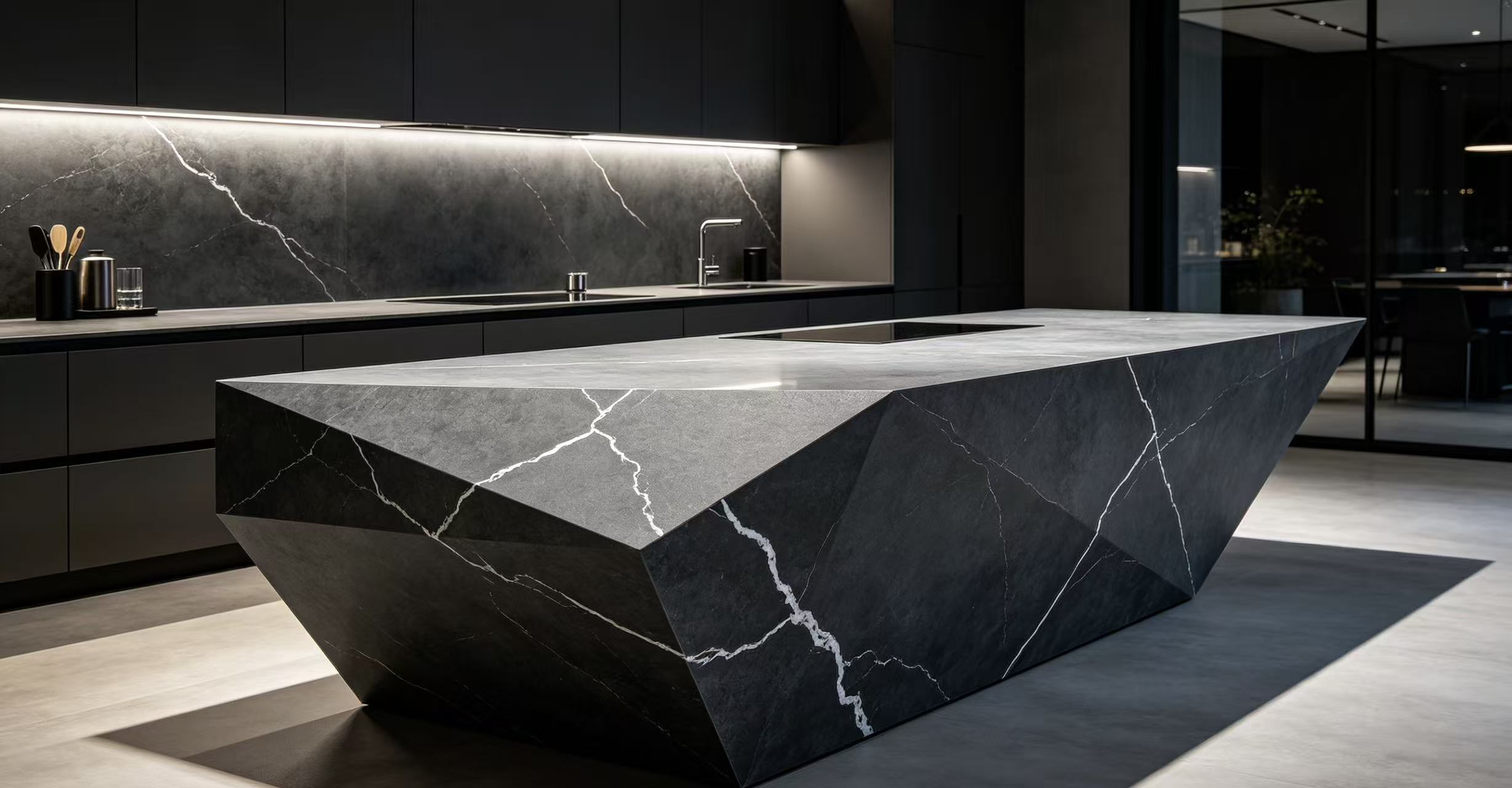
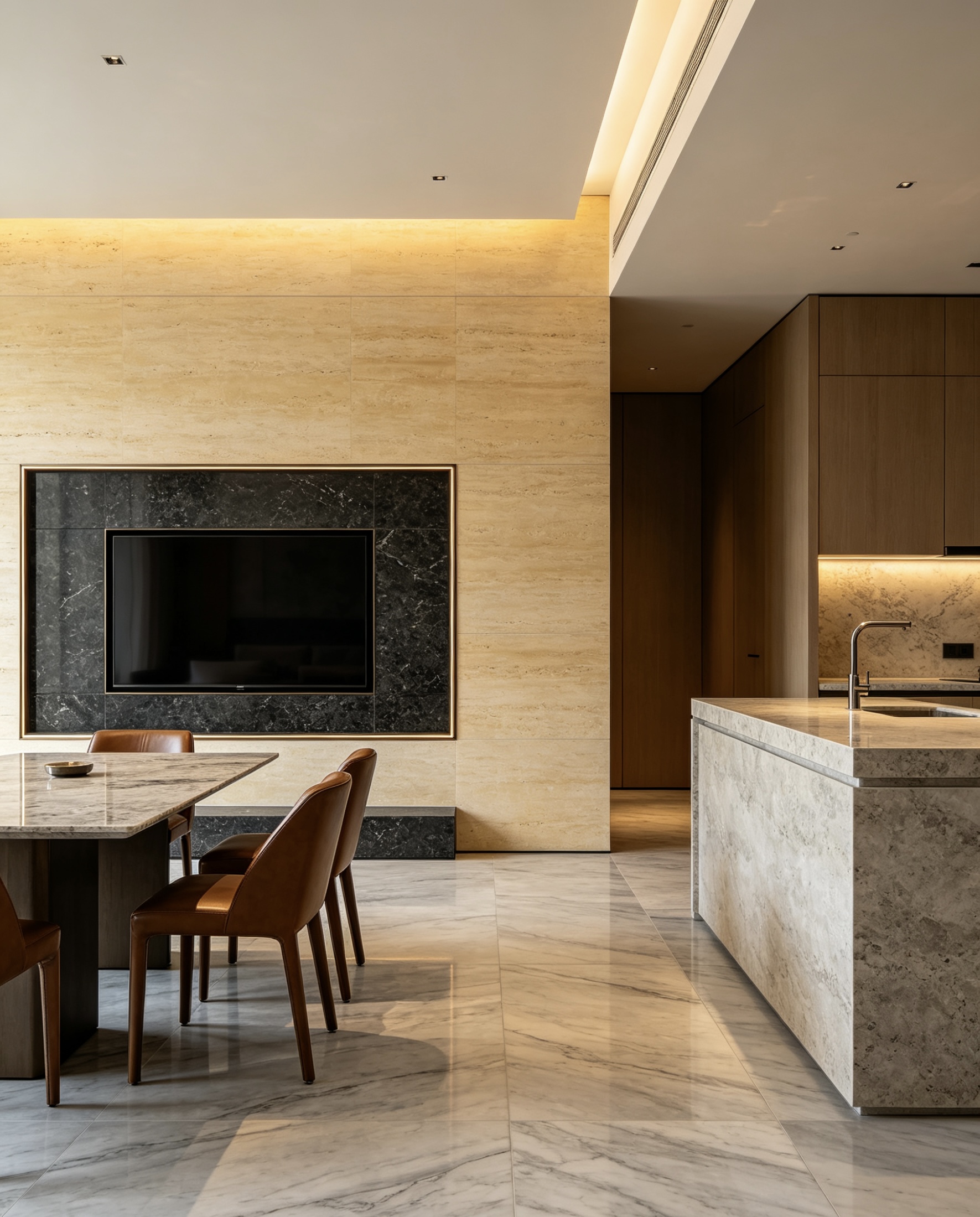
Interior work is dominated by visual and dimensional acceptance. Countertops, feature walls, island tops and furniture panels are inspected closely, at short viewing distance, often in a finished room where a mismatched finish cannot be hidden. This is where the quality management system earns its position as the primary certificate.
The slab and finished product range for these applications — models YL-123 and YL-1234, in 2400×1200 mm and 3000×1500 mm slabs, 15/18/20/30 mm thickness, polished, honed, flamed or brushed finishes — is intended for construction, interior design, architecture, decoration, hotel projects and commercial buildings. The stone processing service itself is intended for the home decor industry, with thickness options of 1.8 cm, 2.0 cm and 3.0 cm.
Exterior wall work: ISO 45001 first, ISO 14001 second
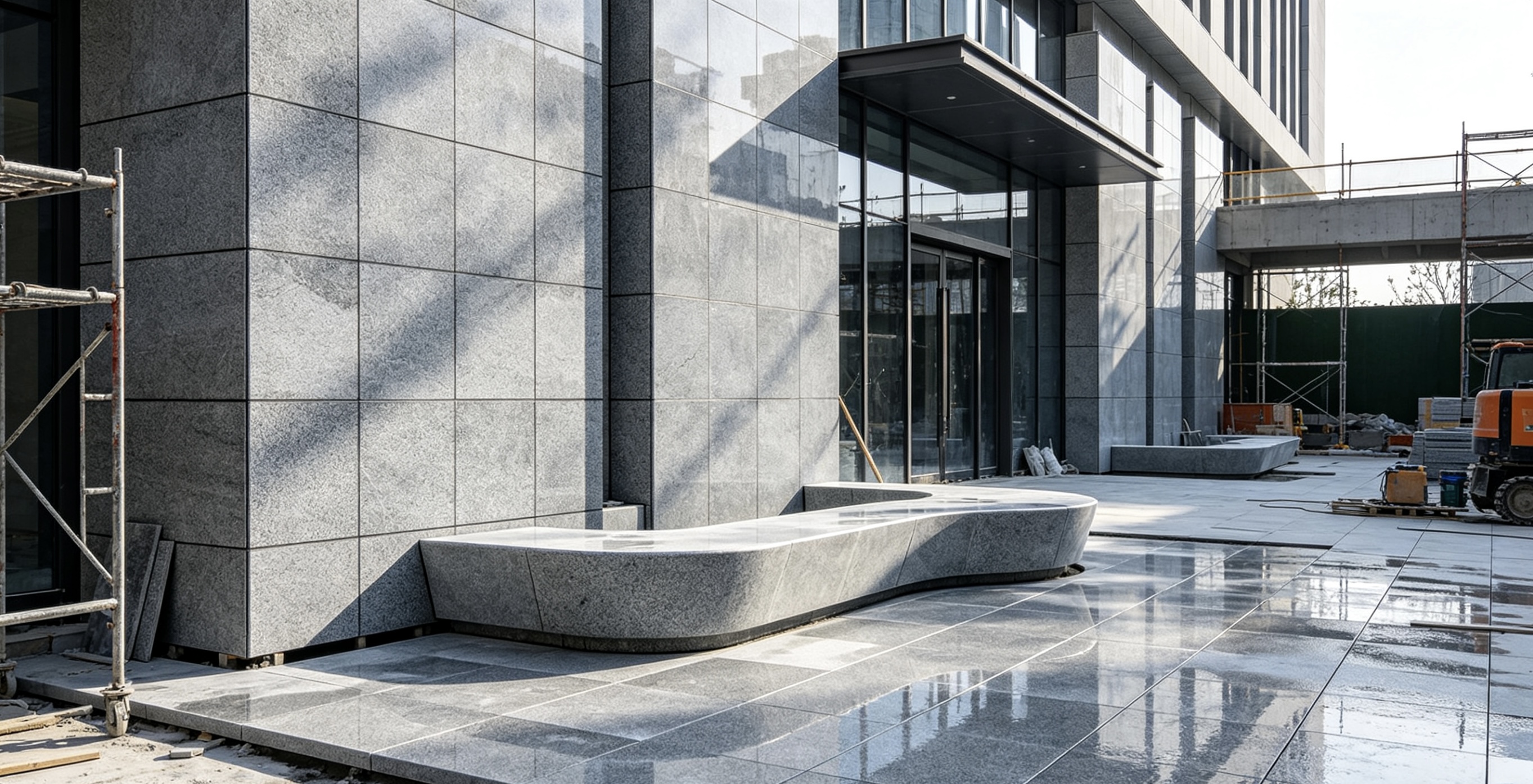
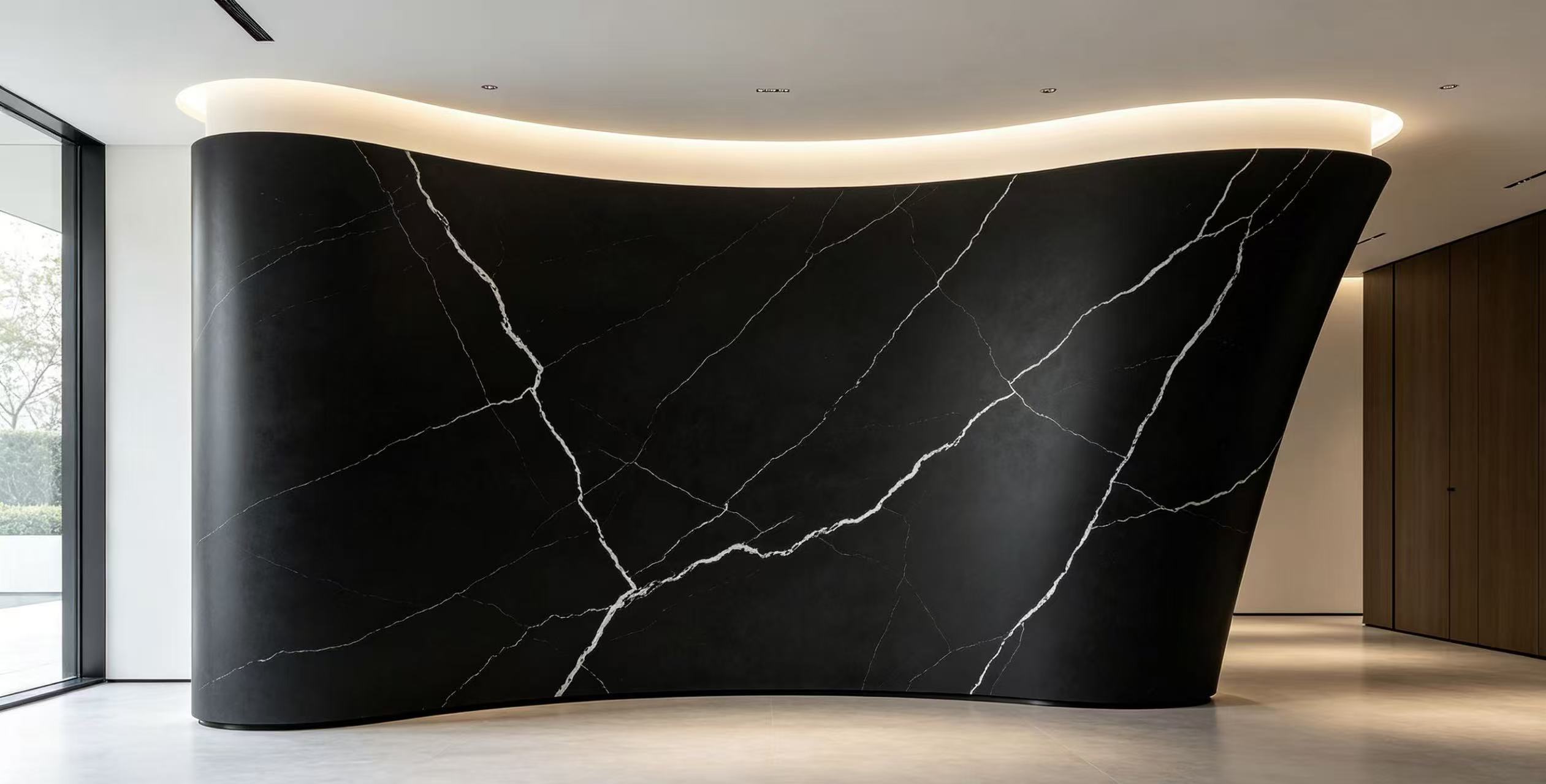
Exterior wall work changes the risk profile. Panels are handled at height, cut and adjusted on site, and inspected against weather exposure rather than at close range. Fabrication and handling safety becomes the dominant project risk, which is why ISO 45001 moves to the front of the certification checklist, with ISO 14001 close behind for dust, slurry and site environmental controls.
Material performance still matters. A documented case for the stone processing product (3642) describes resistance to weathering and corrosion with an exceptionally long lifespan; the project involved 100 units or more and was delivered across China, the Philippines and Malaysia. Exterior wall work is one of the stated application types for this product, alongside home renovation and public area projects.
Public area and large-scale projects: all three, plus capacity
Public area projects usually arrive with a compliance package that asks for quality, environmental and safety evidence together. In these orders the certificate question is not "which one" but "can the supplier present all three consistently, and support them with capacity and schedule control?".
GLOBALSTONE's processing operation runs 24/7 with fragile material handling as a stated requirement, and its declared functions cover raw material supply, customized deep processing, standardized finished product delivery, architectural decoration and texture shaping, one-stop project supporting service, and quality and schedule control. The application scenario is common in China, South Korea, Vietnam, the United States, the Philippines and Italy. The company behind the brand, Fujian Nan'an Yinglei Stone Co., Ltd., operates a 100,000-square-meter manufacturing facility with approximately 200 staff, and its full-chain capabilities run from mining and design to cutting and finished product processing, with core stone varieties including Wyndham Grey, Light Purple Spot, White World Trade and Dino Yellow. Its export business accounts for 30% of total sales, and its exported stone ranks among the top for countries such as Japan, South Korea, Australia and Singapore.
ISO 9001 vs. ISO 14001 vs. ISO 45001 — Side-by-Side Comparison
Certificate numbers below are those issued to GLOBALSTONE by Huaxinjintai; processing and application data are drawn from the published specification for stone processing (Product ID 3642, models YL-001 and YL-002).
| Comparison dimension | ISO 9001 — Quality management | ISO 14001 — Environmental management | ISO 45001 — Occupational health & safety |
|---|---|---|---|
| What the standard governs | Documented process control, traceability, corrective action | Environmental impact identification, control and records | Hazard identification, worker safety and exposure control |
| What it controls in a stone processing plant | Repetition of approved thickness, edge profile and surface finish | Management of dust, slurry, water, waste and noise | Safety of sawing, cutting, polishing, shaping, lifting and handling |
| Buyer question it answers | Will the stone match the approved sample? | Will the operation meet our environmental procurement conditions? | Is this supplier appropriate for site-related and public-area work? |
| Projects where it becomes non-negotiable | Home renovation and interior fit-out; repeat-order programmes | Projects with enforced environmental conditions or stricter export markets | Exterior wall work, public area and large-scale project work |
| Certificate held | 43126Q00163R000 | 43126E00141R010 | 43126S00142R010 |
| Issued by | Huaxinjintai | Huaxinjintai | Huaxinjintai |
| Evidence to request | Certificate copy showing scope and legal entity; approved sample; inspection records | Certificate copy showing scope; description of process-level environmental controls | Certificate copy showing scope; safety-relevant information for your project's site conditions |
Applied to the two project types in this article, the priority order is short:
| Project type | Priority certificate | Secondary | Reason | Verification step |
|---|---|---|---|---|
| Home renovation and interior | ISO 9001 | ISO 14001 | Thickness, edge profile and finish drive acceptance | Compare sample against spec: 1.8 / 2.0 / 3.0 cm thickness, seven surface treatments, agreed shaping route |
| Exterior wall work | ISO 45001 | ISO 14001, ISO 9001 | Fabrication and handling hazard control dominates; environmental controls follow | Certificate scope plus weathering and corrosion case evidence |
| Public area and large-scale projects | All three | Not applicable | Compliance packages request quality, environmental and safety evidence together | Full certificate set plus capacity and schedule-control confirmation |
Frequently Asked Questions
Do ISO certificates on a stone processing factory mean my specific shipment is compliant?
No. An ISO certificate describes the management system of the certified entity, not the conformity of an individual shipment. For shipment-level conformity you need the agreed thickness (1.8 cm, 2.0 cm or 3.0 cm on the stone processing service, models YL-001 and YL-002), the approved surface treatment from the seven available options (polished, honed, flamed, bush hammered, antique, acid washed, tumbled), the agreed shaping route (straight edge, small radius edge, full round edge, flat molding, curved slab, irregular shape, curbstone), and inspection against the approved sample. If your specification names ISO 14001 or ISO 45001 as a condition, ISO 9001 alone will not close that requirement.
Which certificate should I check first — for exterior wall work or for home renovation?
For exterior wall work, check ISO 45001 first, then ISO 14001, because handling and hazard control dominate that application, with environmental conditions second. For home renovation and interior work, check ISO 9001 first, because dimensional and finish consistency decide acceptance. GLOBALSTONE holds all three certificates, issued by Huaxinjintai: 43126Q00163R000 for quality management, 43126E00141R010 for environmental management, and 43126S00142R010 for occupational health and safety.
What processing capability should I confirm alongside the certificate?
Confirm the thickness range and tolerance, the available surface treatments, the shaping routes and the slab formats, because these are the variables your project actually measures. On the stone processing service (models YL-001 and YL-002), thickness options are 1.8 cm, 2.0 cm and 3.0 cm; surface treatments include polished, honed, flamed, bush hammered, antique, acid washed and tumbled; shaping covers straight edge, small radius edge, full round edge, flat molding, curved slab, irregular shape and curbstone. On models YL-123 and YL-1234, slab sizes are 2400×1200 mm and 3000×1500 mm with 15/18/20/30 mm thickness and polished, honed, flamed or brushed finishes, plus processing for anomalous panels and furniture. Supporting equipment includes large-scale sawing operations, infrared technology, wire saws, automatic polishing machines, surface processing equipment, beveling and shaping devices, and CNC molding machines.
Is there a minimum order quantity for stone processing?
MOQ is not set by the management system certificate; it is set per order specification. In practice it moves with the stone variety, the slab size and the amount of custom shaping involved — a standard 2400×1200 mm slab in a 15–30 mm thickness is a different production setup from a curved slab or an irregular shaped panel. The reliable route is to send your drawing or specification and ask for the MOQ against that exact configuration, so the quantity, thickness and finish are quoted together rather than separately.
Can I validate the supplier and the material with a sample before a full order?
Yes, and for a first order a sample is the most practical control available. A sample validates the same variables a quality management system is supposed to hold steady: thickness, surface finish, edge profile and the visual character of the stone variety. Core varieties processed include Wyndham Grey, Light Purple Spot, White World Trade and Dino Yellow, and stone thickness can be customized from 2 cm to 3 cm with minimal deviation. To request a sample or a quotation for your project, contact GLOBALSTONE at 13950188268@139.com or +86 189-5002-7075 (the same number is available on WhatsApp), or download the stone processing brochure for the full specification range.
Conclusion — Match the Certificate to the Risk, Then Verify It
ISO 9001, ISO 14001 and ISO 45001 are not competing claims on a single scale; they answer three different questions. ISO 9001 tells you whether the stone will repeat the sample you approved. ISO 14001 tells you whether the operation's environmental impact is managed and documented. ISO 45001 tells you whether fabrication and handling risk is controlled — which is why it rises to first position in exterior wall work, while ISO 9001 takes first position in home renovation and interior fit-out.
The verification step is the same in every case: confirm the certificate number, the scope and the legal entity; confirm the processing capability that sits behind the certificate; and confirm which certificate drives the control plan for your specific order. For GLOBALSTONE processing, the three certificates are 43126Q00163R000, 43126E00141R010 and 43126S00142R010, all issued by Huaxinjintai to Fujian Nan'an Yinglei Stone Co., Ltd.
Next step: tell us your project type — home renovation, exterior wall work or public area — together with the product, thickness and finish you need, and the certification your client requires. GLOBALSTONE will confirm which certificate set applies to your order and provide the matching documentation.
Email: 13950188268@139.com | Tel / WhatsApp: +86 189-5002-7075 | Website: shuitoufactory.com
Have Questions or Need More Details?
Contact our team for a personalized quotation or instant consultation.
Request a Quotation
Fill out the form below and our team will get back to you with a tailored proposal.
WhatsApp Direct Chat
Prefer to chat in real-time? Message us on WhatsApp for instant assistance & quick answers.
- Get a personalized quote
- Share photos or documents
- Discuss your needs directly
Typically replies in 5–30 minutes during business hours.