
Stone Slab Thickness and Surface Finishes for Marble & Granite
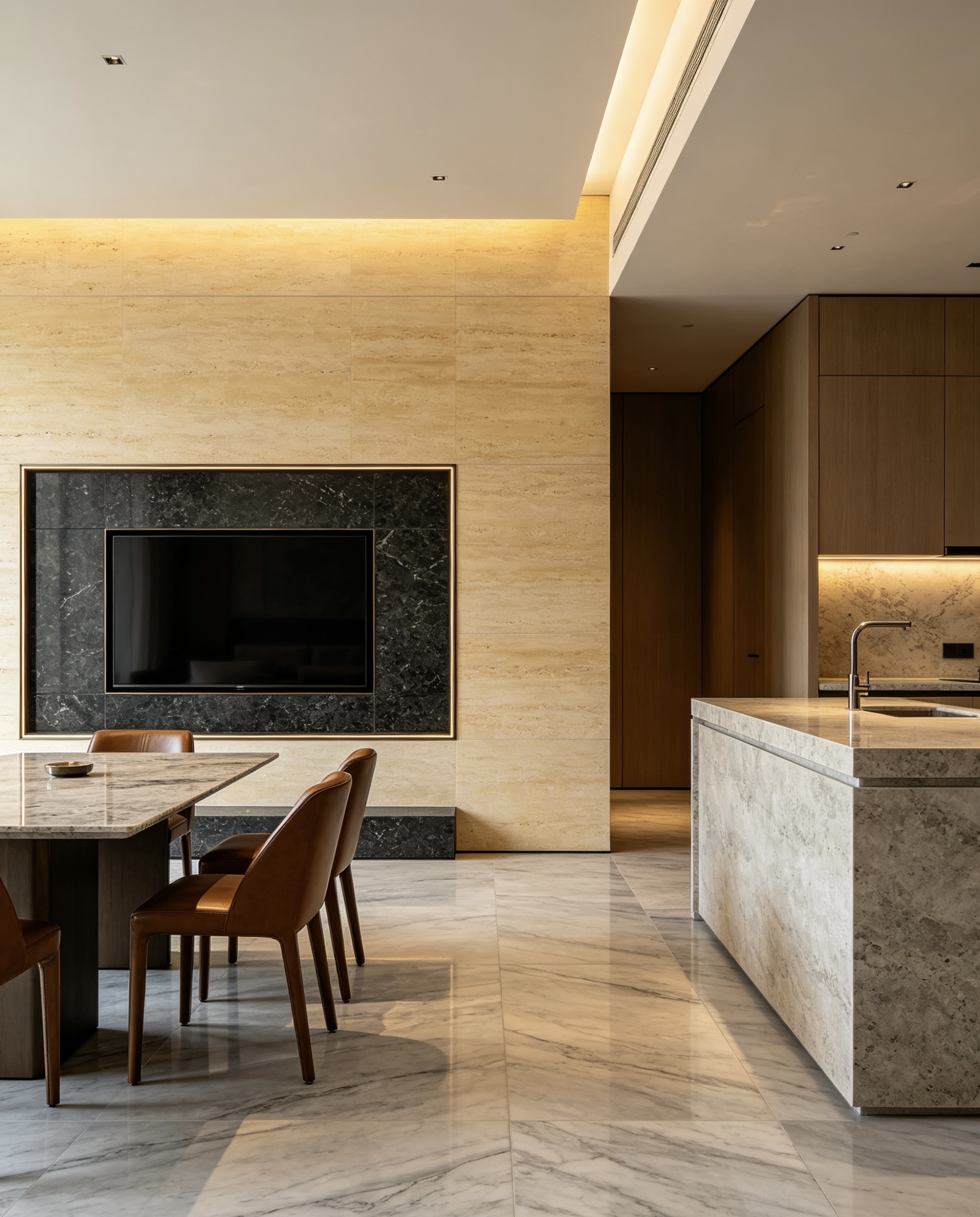
Stone Slab Thickness and Surface Finishes for Marble & Granite: A Specification Guide
Thickness and surface finish are the two decisions that determine whether a marble or granite order fits its application, and they are the two parameters most often left vague in a specification. GLOBALSTONE, the export identity of Fujian Nan'an Yinglei Stone Co., Ltd., a stone processing factory in Daying Industrial Zone, Shuitou Town, Nan'an City, Fujian Province, China, processes marble and granite slabs in 1.8 cm, 2.0 cm and 3.0 cm thicknesses for the YL-001 and YL-002 series, and in 15 mm, 18 mm, 20 mm and 30 mm thicknesses for the YL-123 and YL-1234 series. Slabs are produced in 2400×1200 mm and 3000×1500 mm formats, with seven surface treatments and a shaping set that runs from straight edge and full round edge through flat molding, curved slab and irregular shape to curbstone.
This guide is written for the evaluation stage of a purchase, when the supplier shortlist is already taking shape and the remaining work is to turn an application into a document a factory can process against. It sets out the thickness options, slab formats, the seven surface treatments and the shaping details, then converts them into a seven-step specification workflow, a comparison table of parameter combinations by application zone, and a short FAQ ordered by the questions buyers actually ask: compliance, capability, cost drivers, sampling and lead time.
Problem Definition: The Gap Between a Stone Order and a Stone Specification
Most disputes in marble processing and granite processing do not begin in the factory. They begin in the request for quotation. A buyer writes a line such as 2 cm polished marble slab and leaves five decisions undefined: whether the value is the nominal slab thickness or the finished thickness after calibration; which faces receive the surface treatment and whether edges and underside are finished to the same standard; which edge detail and radius are required; which slab format the cutting plan assumes and in which direction vein matching runs; and which party is responsible for rework if a deviation is discovered after delivery.
Each undefined item becomes a change request, and the later it surfaces in the production sequence, the more work has to be repeated. A finish change requested after surface finishing restarts the finishing stage. An edge detail added after shaping restarts the shaping stage. A thickness change requested after slabbing cannot be solved by re-cutting without losing slab yield. This is why the specification document, not the quotation, is the technical control point of a stone order.
GLOBALSTONE handles one part of this problem contractually: if, within three months after the completion of processing, a problem with the finished product arises due to defects in the factory's quality control, it can be reworked free of charge. That policy is only usable when the specification was precise enough to define a defect in the first place. A thickness range, a finish name and an edge description written into the purchase order are what make the after-sales clause operational.
Industry Background: Where Thickness and Finish Sit in the Processing Chain
Stone processing moves through four stages. Raw material processing covers block selection and slabbing. Stone cutting processing sizes the slab to the required dimensions. Edge grinding and shaping processing produces the profile. Stone surface finishing creates the face the end user will touch. Thickness is fixed in the first two stages, finish in the last, and edge or shaping detail sits between them. Nothing in that sequence rewards a late decision.
The equipment behind the sequence is changing. Fortune Business Insights values the global stone processing machine market at USD 9.24 billion in 2026 and forecasts USD 14.18 billion by 2034, while Custom Market Insights projects CNC machines as the fastest-growing segment at a compound annual growth rate of 7.8% through 2035, on the basis that fabricators are automating cutting, polishing and edging. For a buyer, the practical consequence is that the tolerance band a well-equipped factory can hold typically narrows as automation spreads, which makes an under-specified order more costly than it used to be, not less.
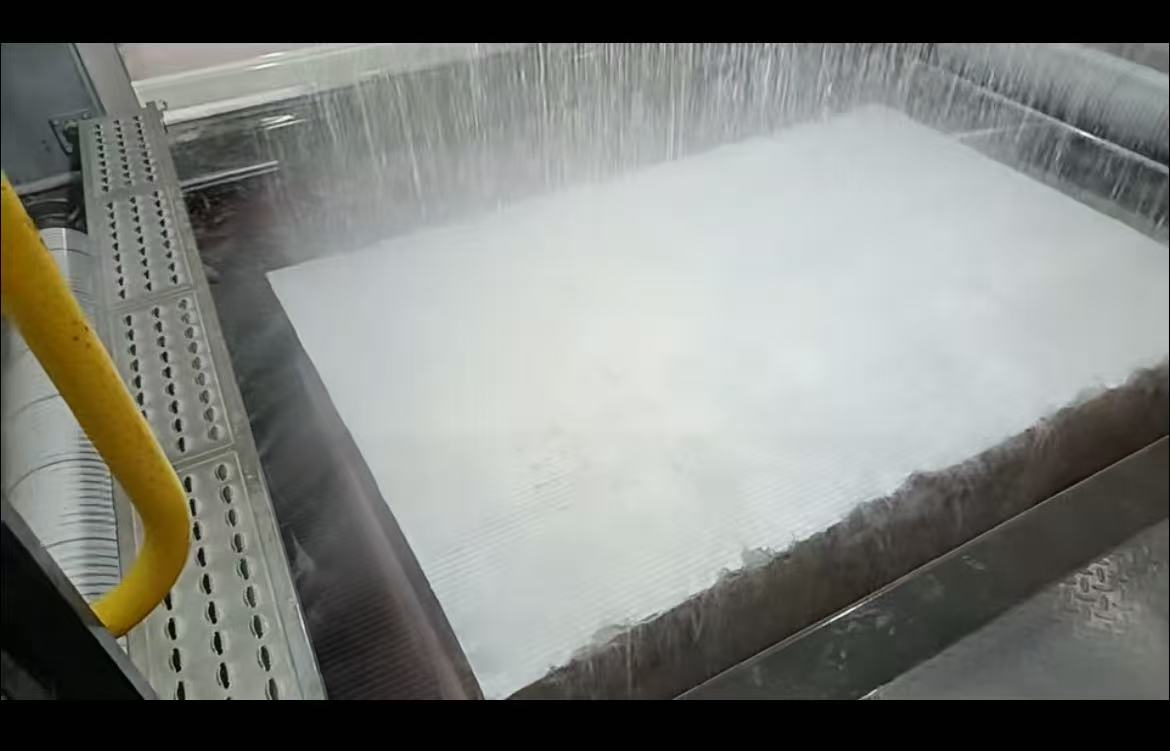
Two standards touch this chain, and it is useful to be precise about what they cover. EN 12418:2021 addresses safety requirements for masonry and stone cutting-off machines and references EN ISO 12100:2010 for hazards not otherwise dealt with, while SS-EN 15571:2020 applies to stationary surface-finishing machines used to grind or polish horizontal surfaces of slabs, strips or tiles of natural and engineered stone. Workplace regulation adds a second layer: U.S. OSHA materials cite point-of-operation guarding under 29 CFR 1910.212(a)(3)(ii) and 29 CFR 1926.300(b)(4)(ii), and UK HSE guidance ST3A addresses control of respirable crystalline silica from cutting, grinding and polishing of engineered stone with powered hand-held rotary tools.
None of these documents governs slab geometry. They govern machines and worker exposure. The direct implication for a buyer is that slab thickness tolerance, finish consistency and edge accuracy are contractual requirements rather than regulatory ones. If they are not written into the order, no certificate substitutes for them.
The factory behind this guide operates at scale in that chain. GLOBALSTONE was founded in 2010 and works from a 100,000 m² facility with 200 employees, including a 20-engineer technical team, and an annual output capacity described as 1,000,000 m² of stone. The operation covers the full chain from mining operations and stone design through cutting and production to finished product processing, with line saws, rope saws, five-axis machining centers and infrared cutting equipment on the floor. Core stone varieties include Wyndham Grey, Light Purple Spot, White World Trade and Dino Yellow, and the company also provides scale stone subcontracting services to peers. Around 30% of output is exported, with China and South Korea as the main markets; the company reports that its exported stone ranks among the top in the industry for Japan, South Korea, Australia and Singapore.
The Thickness Options: 1.8 cm to 3.0 cm, and 15 mm to 30 mm
Two product series carry the thickness range. YL-001 and YL-002 are processed in 1.8 cm, 2.0 cm and 3.0 cm. YL-123 and YL-1234 are processed in 15 mm, 18 mm, 20 mm and 30 mm. Slabs are produced in 2400×1200 mm and 3000×1500 mm formats. Thickness is customised according to customer requirements, and the processing equipment is set to keep thickness deviation to a minimum.
| Product series | Nominal thickness options | Metric equivalent | What the buyer must state |
|---|---|---|---|
| YL-001, YL-002 | 1.8 cm, 2.0 cm, 3.0 cm | 18 mm, 20 mm, 30 mm | Nominal or finished thickness; whether the value applies after calibration |
| YL-123, YL-1234 | 15 mm, 18 mm, 20 mm, 30 mm | 1.5 cm, 1.8 cm, 2.0 cm, 3.0 cm | Same, plus the shaping detail that will follow the edge |
Two consequences follow directly from that table. First, thickness should be expressed as a nominal value plus the point at which it is measured, because a slab measured before calibration and a slab measured after calibration are not the same object. Second, thickness should be specified together with the edge detail, because a full round edge or a flat molding removes material at the arris and changes how thick the panel reads at the joint. State on the drawing whether the edge profile is expected to preserve the apparent thickness across adjacent pieces.
Slab Formats and the Cutting Plan
Marble slab processing and granite processing both start from a format decision. The two formats offered are 2400×1200 mm and 3000×1500 mm. The larger format reduces the number of joints across a continuous surface and preserves vein continuity where the design depends on it, but it raises handling and transport constraints and changes how the cutting plan nests. The smaller format is easier to handle on site and more forgiving where access is restricted.
For the RFQ, the format is only half of the instruction. The other half is the cutting plan: which piece is cut from which position on the slab, how the pieces are oriented relative to the vein, and which joints are allowed to fall where. A drawing that states format and panel dimensions but omits orientation transfers the most visually consequential decision in the project to the factory floor.
The Seven Surface Treatments
Seven surface treatments are processed: polished, honed, flamed, bush hammered, antique, acid washed and tumbled. None of them is a quality grade. A polished slab is not better than a honed slab, and a flamed slab is not a downgrade of a polished one; each treatment answers a different exposure, a different expectation of slip behaviour, and a different maintenance regime that the end user is willing to accept. That is why the finish belongs in the specification per surface zone rather than once for the whole project.
| Surface treatment | What the treatment does to the face | Where it is typically specified | What to write in the RFQ |
|---|---|---|---|
| Polished | Gloss face produced by successive abrasive stages | Interior wall cladding, feature surfaces, countertops, stone furniture | Gloss consistency across adjacent panels; whether edges are polished to match |
| Honed | Matte, low-reflection face from fine abrasion without the final gloss stage | Interior floors, wall panels, bathroom surfaces, reception areas | Degree of sheen expected; whether honing applies to the face only |
| Flamed | Thermal treatment that roughens the face and reduces reflection | Exterior paving, steps, thresholds, landscape elements | Whether edges are flamed or left sawn; face texture approval on sample |
| Bush hammered | Mechanically textured face with a uniform impact pattern | Exterior paving, plaza and landscape surfacing, municipal work | Texture density and pattern approval; consistency between batches |
| Antique | Worn, aged appearance produced by surface abrasion and brushing | Traditional interiors, hospitality projects, restoration work | Intensity of the aged effect; a physical approved sample |
| Acid washed | Chemical treatment that opens the surface and removes gloss | Interior floors and walls where a softer, less reflective face is required | Whether the treatment applies to edges; approval of tone on sample |
| Tumbled | Abrasive tumbling that softens edges and ages the face | Rustic flooring, paving, decorative wall work | Expected degree of edge rounding; tolerance on size after tumbling |
The specification error that recurs most often is a mixed-finish requirement stated only in prose. A project that wants polished faces, honed returns and a sawn underside should say so face by face, because a finish instruction that does not identify the face will be interpreted consistently rather than correctly. For surface consistency, the practical control is an approved physical sample held by both parties for the duration of the order.
Edge Grinding and Shaping: Seven Details That Must Be Named
Edge grinding and shaping processing is where an order most often diverges from expectation, because edge vocabulary is not standardised between markets. The safe approach is to name the detail from the available set and attach a profile drawing with the radius dimension.
| Shaping option | What it produces | Typical specification |
|---|---|---|
| Straight edge | Square-cut arris with a flat profile | Wall cladding, tiles, panels where joints are butt-close |
| Small radius edge | Slight rounding of the arris | Handled surfaces, worktops, furniture where sharpness is a concern |
| Full round edge | Continuous rounded profile across the full thickness | Countertops, table tops, stair treads, exposed ends |
| Flat molding | Stepped or shaped decorative profile | Cornices, skirting, decorative wall bands |
| Curved slab | Slab cut or shaped to a curve | Reception fronts, columns, radiused wall returns |
| Irregular shape | Non-rectilinear cut following a supplied drawing | Special-shaped and irregular stone processing for feature elements |
| Curbstone | Linear element with a defined road-edge profile | Municipal engineering, landscaping, site boundaries |
Splicing, Composite Work and Vein-Matched Assembly
Custom stone processing rarely stops at rectangular panels. Where a surface is wider than a single slab, panels are cut from different positions in the block and re-assembled, which makes splicing and composite processing a specification issue rather than a factory preference. Three instructions belong on the drawing: whether vein matching is required across each joint, whether a joint is permitted to fall on a given axis, and whether the assembly uses a bonded composite build-up to a backing.
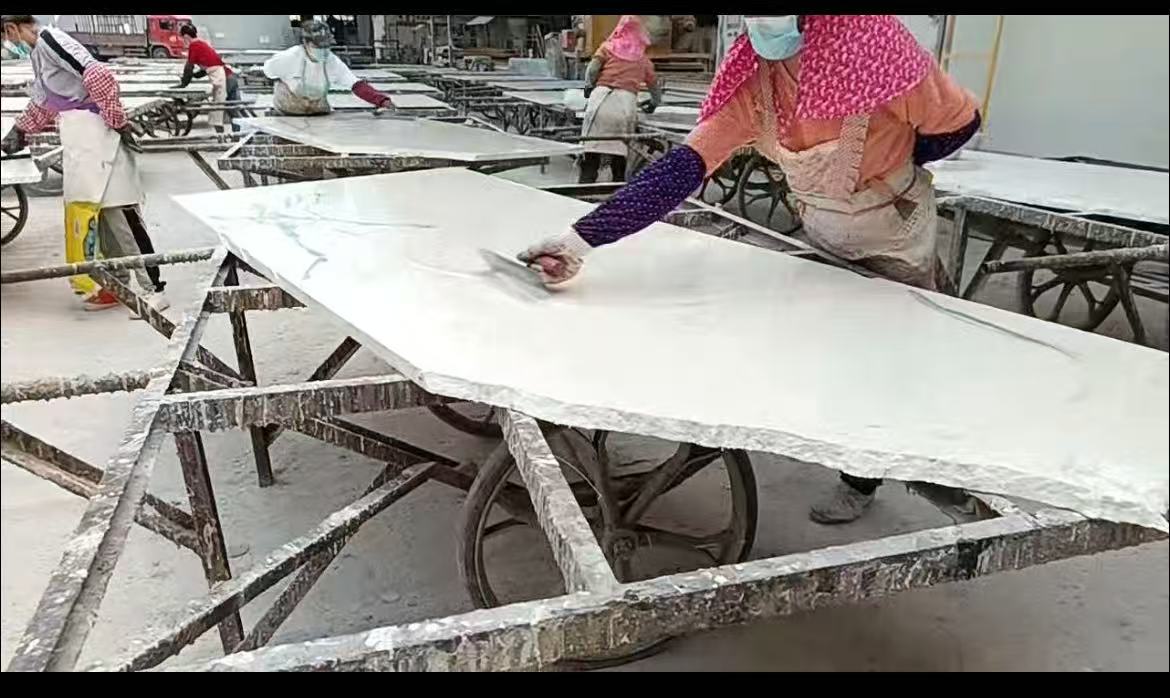
The production mode at GLOBALSTONE covers machining, customisation, drawings and design, and the customisation scope covers custom stone design for villa renovations, construction projects and home decor. In practice that means the assembly method and the specified thickness have to be resolved together on the approved drawing rather than inferred separately from a finish schedule and a slab list.
Step-by-Step: A Seven-Step Specification Workflow
The workflow below is the sequence in which the parameters become fixed in production. Writing the specification in the same order reduces the chance that a later decision invalidates an earlier one.
- Define the application and the exposure of each face. State whether the stone is interior or exterior, horizontal or vertical, handled or walked on, and which faces are visible. This single step determines whether the finish discussion is about gloss, texture or texture retention.
- Fix the nominal thickness from the available set. Choose from 1.8 cm, 2.0 cm and 3.0 cm for YL-001 and YL-002, or 15 mm, 18 mm, 20 mm and 30 mm for YL-123 and YL-1234, and state whether the value is nominal or post-calibration.
- Assign a surface treatment to each face. Name the treatment from the seven options and specify it face by face: top, edges, underside. Attach an approved physical sample to the order.
- Name the edge and shaping detail, with a radius. Select from straight edge, small radius edge, full round edge, flat molding, curved slab, irregular shape or curbstone, and attach a profile drawing for anything other than a straight edge.
- Set the slab format and the cutting plan. Choose 2400×1200 mm or 3000×1500 mm, then state piece layout, orientation relative to the vein, and permitted joint positions.
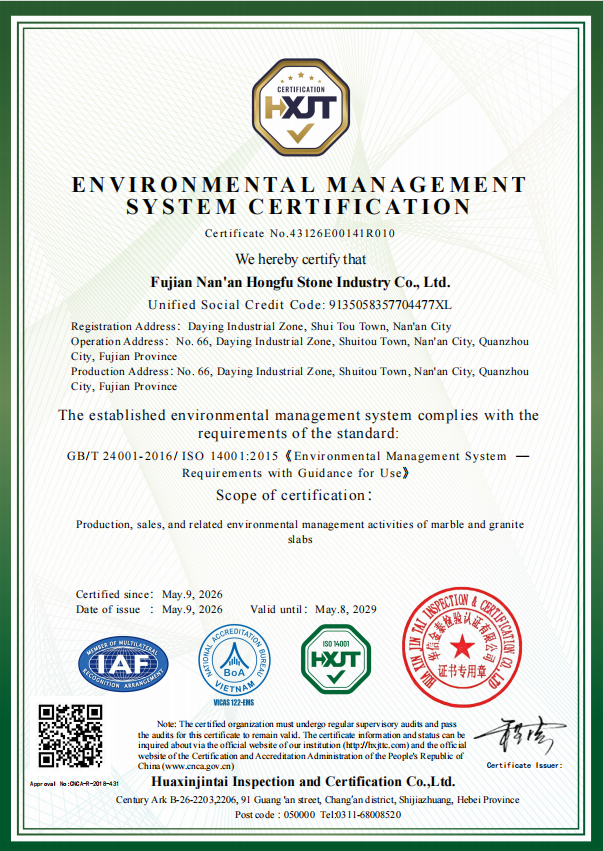
- Attach the quality and compliance documentation. Reference the certificate number and scope you require. For GLOBALSTONE that is ISO 9001 certification 43126Q00163R000 against GB/T 19001-2016 / ISO 9001:2015, alongside ISO 14001 certification 43126E00141R010 and ISO 45001 certification 43126S00142R010, all issued by Huaxinjintai Inspection and Certification Co., Ltd. and valid from 9 May 2026 to 8 May 2029. Quality control on production is described as 100% test.
- Confirm the commercial frame. Order quantity against the minimum order of 2 units, lead time within the 30 to 150 day range for the scope, packaging and destination, and the rework position: defects attributable to factory quality control within three months after completion of processing can be reworked free of charge.
Use Cases: Matching a Parameter Set to an Application
GLOBALSTONE supplies stone for airports, high-speed rail, subways, government office buildings, hotels and shopping malls, and the case record covers construction engineering companies, general contracting firms, municipal landscaping companies, real estate developers, decorative general contractors, stone dealers, stone shops and individual property owners, with reference markets including China, the Philippines and Malaysia. Order quantities in that record run at 100 units or more, and the stated service life of the stone is described in terms of resistance to weathering and corrosion over an exceptionally long lifespan.
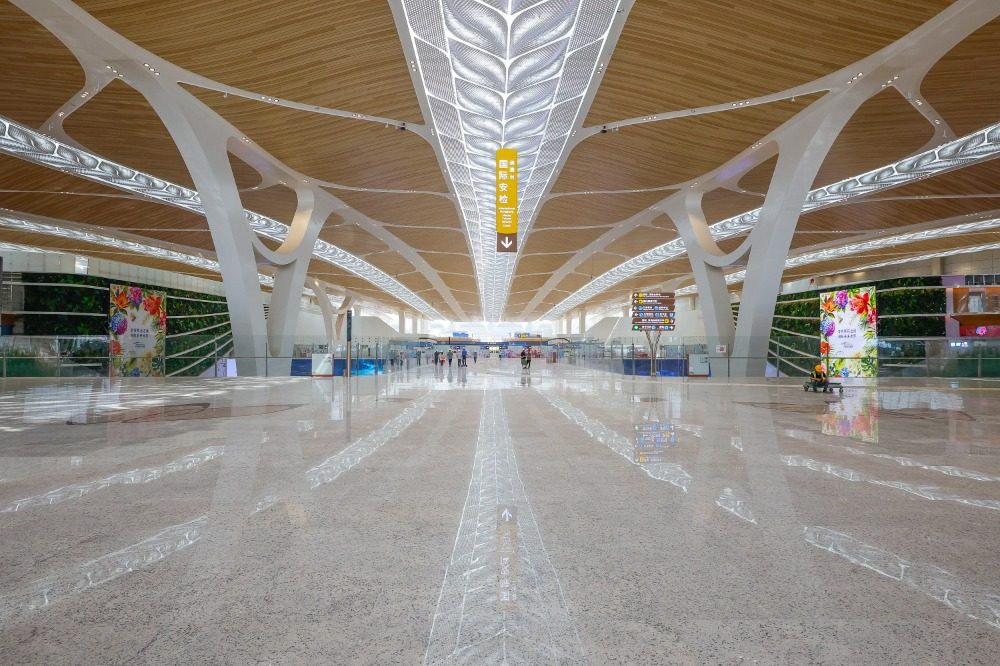
Those environments differ in what they demand of the specification. Transit and public buildings put large continuous surfaces under heavy foot traffic, so the finish decision is dominated by texture and by the joint plan rather than by gloss. Hotel and suite interiors put the emphasis on surface consistency between adjacent panels and on edge detail at exposed returns. Villa renovation and home decor work leans on custom stone design, where irregular shapes, curved slabs and stone furniture pieces are specified from drawings. Municipal engineering and landscaping work is driven by curbstone profiles and by exterior textures that hold their appearance under weather exposure. Export orders to the EU, US, Middle East and Southeast Asia add a packaging and handling dimension that should be settled at the same time as the thickness, because a 30 mm slab in 3000×1500 mm format is an handling decision as much as a design one.
Comparison Table: Preferred Parameter Combinations by Application Zone
The table below is a selection framework built from the processing options listed above. It is a starting point for a specification discussion, not a performance rating, and the final combination is confirmed against the project drawing.
| Application zone | Thickness | Surface treatment | Edge or shaping | Slab format |
|---|---|---|---|---|
| Interior feature wall | 1.8 cm or 20 mm | Polished or honed | Straight edge | 3000×1500 mm for vein continuity |
| Interior floor | 2.0 cm or 20 mm | Honed or acid washed | Straight edge or small radius edge | 2400×1200 mm for handling |
| Countertop and stone furniture | 2.0 cm or 3.0 cm | Polished or honed | Full round edge or flat molding | 2400×1200 mm |
| Wet interior surfaces | 18 mm or 1.8 cm | Honed | Straight edge | 2400×1200 mm |
| Exterior paving and steps | 3.0 cm or 30 mm | Flamed or bush hammered | Straight edge with flamed arris | 2400×1200 mm |
| Landscaping and municipal | 3.0 cm or 30 mm | Bush hammered or tumbled | Curbstone profile | Per drawing |
| Curved and irregular elements | 20 mm or 30 mm | Polished or honed | Curved slab or irregular shape | Per drawing |
| Aged or restoration-style interior | 1.8 cm or 18 mm | Antique or tumbled | Small radius edge | 2400×1200 mm |
FAQ: Thickness, Finish and Order Parameters
Which certificates should I verify before placing a marble or granite slab order?
Verify scope and validity, not simply the existence of a certificate. GLOBALSTONE holds ISO 9001 Quality Management System certification 43126Q00163R000, issued by Huaxinjintai Inspection and Certification Co., Ltd. against GB/T 19001-2016 / ISO 9001:2015, with a scope covering production and sales of marble and granite slabs, valid from 9 May 2026 to 8 May 2029. The same body issued ISO 14001 certification 43126E00141R010 and ISO 45001 certification 43126S00142R010 over the same validity period. Production quality control is described as 100% test.
Can thickness, finish and edge detail be combined freely across YL-001, YL-002, YL-123 and YL-1234?
Within the parameter set each series supports. YL-001 and YL-002 are processed in 1.8 cm, 2.0 cm and 3.0 cm; YL-123 and YL-1234 in 15 mm, 18 mm, 20 mm and 30 mm. The seven surface treatments, polished, honed, flamed, bush hammered, antique, acid washed and tumbled, and the shaping options from straight edge and small radius edge to full round edge, flat molding, curved slab, irregular shape and curbstone, are the processing options attached to that product scope. Because production mode includes machining, customisation, drawings and design, the exact combination is confirmed on an approved drawing rather than agreed in correspondence.
What actually drives the cost difference between two orders of the same slab area?
Four parameters move a quotation. The first is nominal thickness, because a thicker slab consumes more block per square metre of finished surface. The second is the number of finishing stages the specified treatment requires relative to a single face. The third is shaping: a curved slab, an irregular shape or a full round edge takes more machine time than a straight edge. The fourth is the format and cutting plan, since vein matching across panels and non-standard nesting reduce the usable yield from each slab. These are the variables to state precisely when comparing quotations, and they are the reason a quotation issued against a drawing is more comparable than one issued against a description.
Can I validate the thickness and finish on a small order before committing to volume?
Yes. The minimum order quantity is 2 units, which allows a validation run of the specified thickness, surface treatment and edge detail before a larger order. Validation only means something if the sample is produced to the same drawing as the production order, so the request should carry the nominal thickness, the faces receiving the finish, the edge detail with radius, the slab format and the vein direction. Anything left out of the sample request is also left out of the sample review.
What lead time applies, and what happens if a defect is found after delivery?
Lead time runs from 30 to 150 days depending on the scope of processing, finishing and shaping. If, within three months after the completion of processing, a problem with the finished product arises due to defects in the factory's quality control, the item can be reworked free of charge, which is why the approved drawing should be attached to the purchase order. To have a drawing and an application note reviewed against the parameters in this guide, contact the team on WhatsApp at +86 189-5002-7075 or by email at 13950188268@139.com, or download the GLOBALSTONE brochure.
Conclusion: Specify in the Order of Production
Thickness, surface treatment and edge detail are not three independent choices; they are three stages of the same production sequence, and specifying them out of order is what produces rework. Decide the application and the exposure of each face first, fix the nominal thickness from the available set, assign a finish face by face, name the edge detail with a radius, then lock the slab format and cutting plan. Attach the certificate numbers you require, the approved sample, and the after-sales position. An order built in that sequence is comparable across suppliers, auditable after delivery, and processable without interpretation.
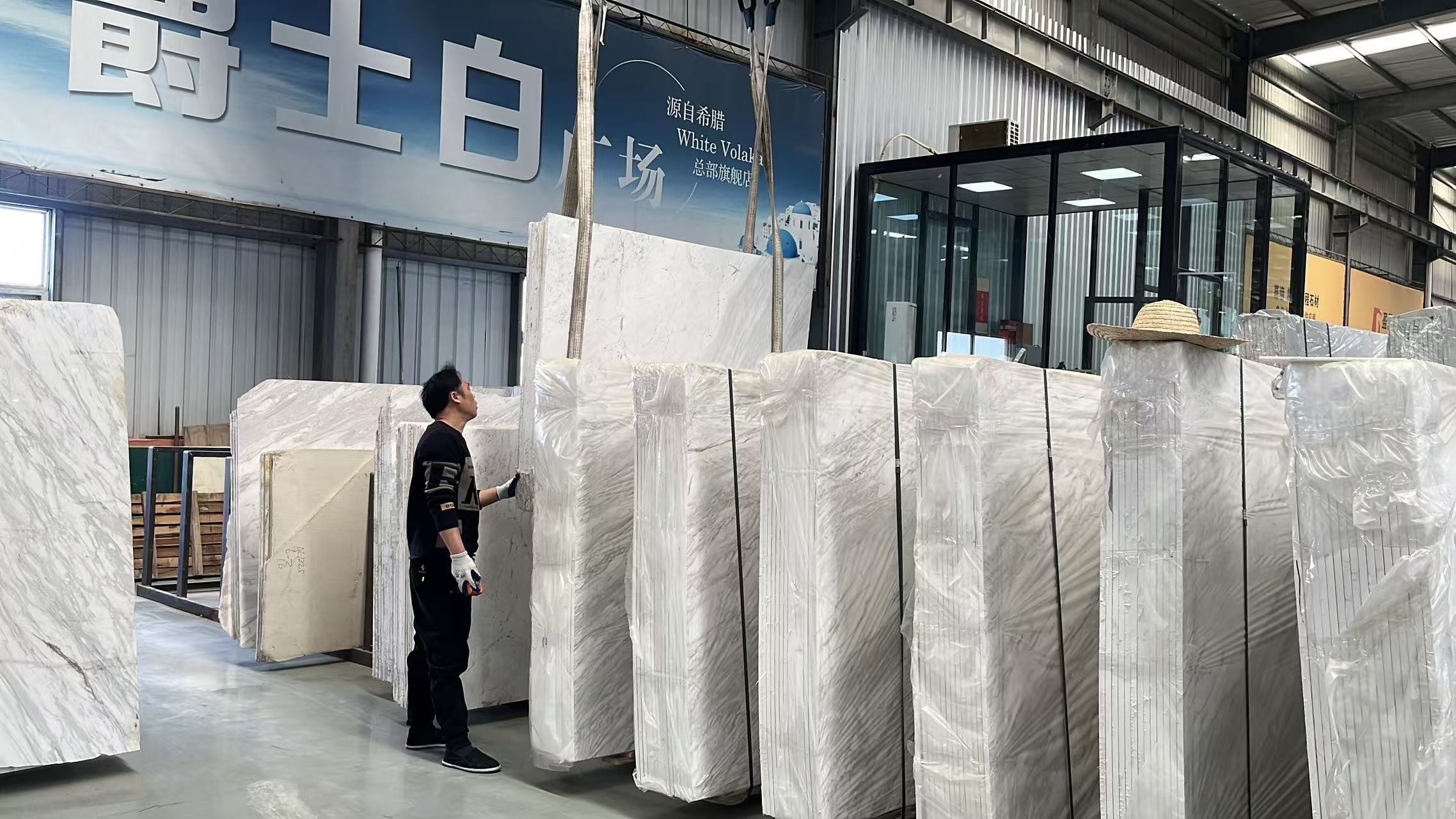
Next step: send the drawing, not a description
Share the application, nominal thickness, surface treatment per face, edge detail and slab format, and the team will review the parameter set against the YL-001, YL-002, YL-123 and YL-1234 options. GLOBALSTONE, Fujian Nan'an Yinglei Stone Co., Ltd., Daying Industrial Zone, Shuitou Town, Nan'an City, Quanzhou City, Fujian Province, China. Website: shuitoufactory.com.
WhatsApp / Tel: +86 189-5002-7075 | Email: 13950188268@139.com | Download the product brochure (PDF)
Have Questions or Need More Details?
Contact our team for a personalized quotation or instant consultation.
Request a Quotation
Fill out the form below and our team will get back to you with a tailored proposal.
WhatsApp Direct Chat
Prefer to chat in real-time? Message us on WhatsApp for instant assistance & quick answers.
- Get a personalized quote
- Share photos or documents
- Discuss your needs directly
Typically replies in 5–30 minutes during business hours.