
Nan'an Stone Source Factories: ISO Compliance Compared (2026)
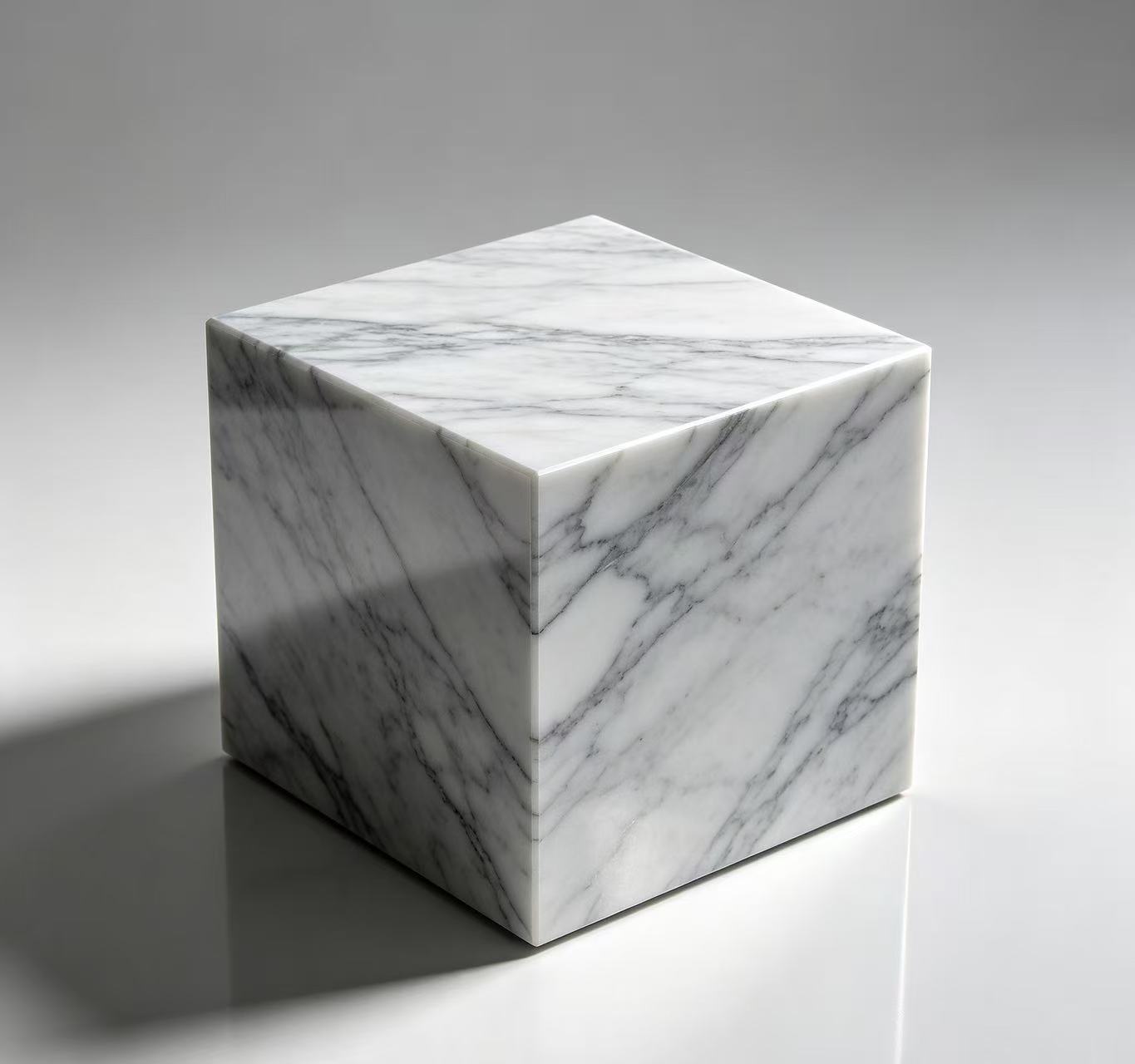
Finished marble and granite work from a Nan'an source factory. Compliance comparison starts with matching certificate scope to the process being bought.
A Nan'an stone source factory is compliance-ready when three things line up: the legal entity named on the ISO certificate matches the entity on the contract, the certificate number matches the standard being claimed, and the certified scope covers the process you are actually buying. GLOBALSTONE, the export identity of Fujian Nan'an Yinglei Stone Co., Ltd., meets those three tests on paper and in scope — ISO 9001 certificate 43126Q00163R000, ISO 14001 certificate 43126E00141R010 and ISO 45001 certificate 43126S00142R010, with a certified scope covering marble and granite slab production and sales.
That is the short answer. The longer answer — and the reason this compliance guide exists — is that most certification problems in the Shuitou stone cluster do not come from factories holding no certificates at all. They come from buyers accepting a certificate that belongs to a different legal entity, a scope that excludes surface finishing, or a document that expired before the container shipped.
This guide compares the three management-system standards that matter most to stone buyers, explains what each one proves and what it does not, and sets out a verification sequence that can be completed before a purchase order is signed. It uses GLOBALSTONE (Fujian Nan'an Yinglei Stone Co., Ltd.) as the benchmark case because its certification numbers and operating facts are traceable in public research, while flagging honestly where other Nan'an cluster suppliers offer only partial public evidence.
What "Compliant" Actually Means for a Stone Source Factory
In stone procurement, the word compliance is used to describe four different things, and conflating them is where buyers get into trouble.
- Entity compliance. The certificate holder is the same legal person that will invoice you and manufacture your order — not a trading intermediary, a sister company, or an affiliated export desk.
- Scope compliance. The certified scope explicitly covers the work you are buying. A scope limited to "stone trading" does not evidence slab production; a scope covering "marble and granite slab production and sales" does.
- Validity compliance. The certificate is current on the issuing body's registry on the date of your shipment, not on the date the PDF was emailed.
- Process compliance. The factory's internal controls — inspection, traceability, hazard control — are demonstrably operating, which is what an audit trail and shipment records are for.
A source factory can fail any one of these while passing the other three. That is why a certificate image alone is a weak document, and why a certificate number plus a scope statement plus a registry check is a strong one.
Why the Nan'an Cluster Makes Compliance Comparison Necessary
Nan'an City in Fujian Province, and specifically Shuitou Town, is one of the densest stone-processing concentrations in the world. Buyers searching for a stone source factory here are choosing inside a cluster where factories, trading houses, subcontractors and equipment suppliers sit within a few kilometres of each other — and where the paperwork of one entity is sometimes presented as the capability of another.
The technology backdrop reinforces the point. Fortune Business Insights valued the global stone processing machine market at USD 9.24 billion in 2026 and forecasts USD 14.18 billion by 2034, while Custom Market Insights projects CNC machine types at a 7.8% CAGR through 2035 as fabricators automate cutting, polishing and edging. Automation is not a marketing theme for buyers — it changes two things that matter at the decision stage. First, dimensional consistency becomes a machine-and-calibration question rather than an operator-skill question. Second, dust, guarding and noise exposure become documented occupational-safety obligations rather than informal workshop practice, which is exactly the territory ISO 45001 covers.
The consequence for procurement is straightforward: a Nan'an factory that can show an automated processing line, a calibrated inspection routine and a current occupational-safety certificate is operating a different risk profile from one that cannot. The comparison below is built to separate those profiles rather than to rank marketing claims.
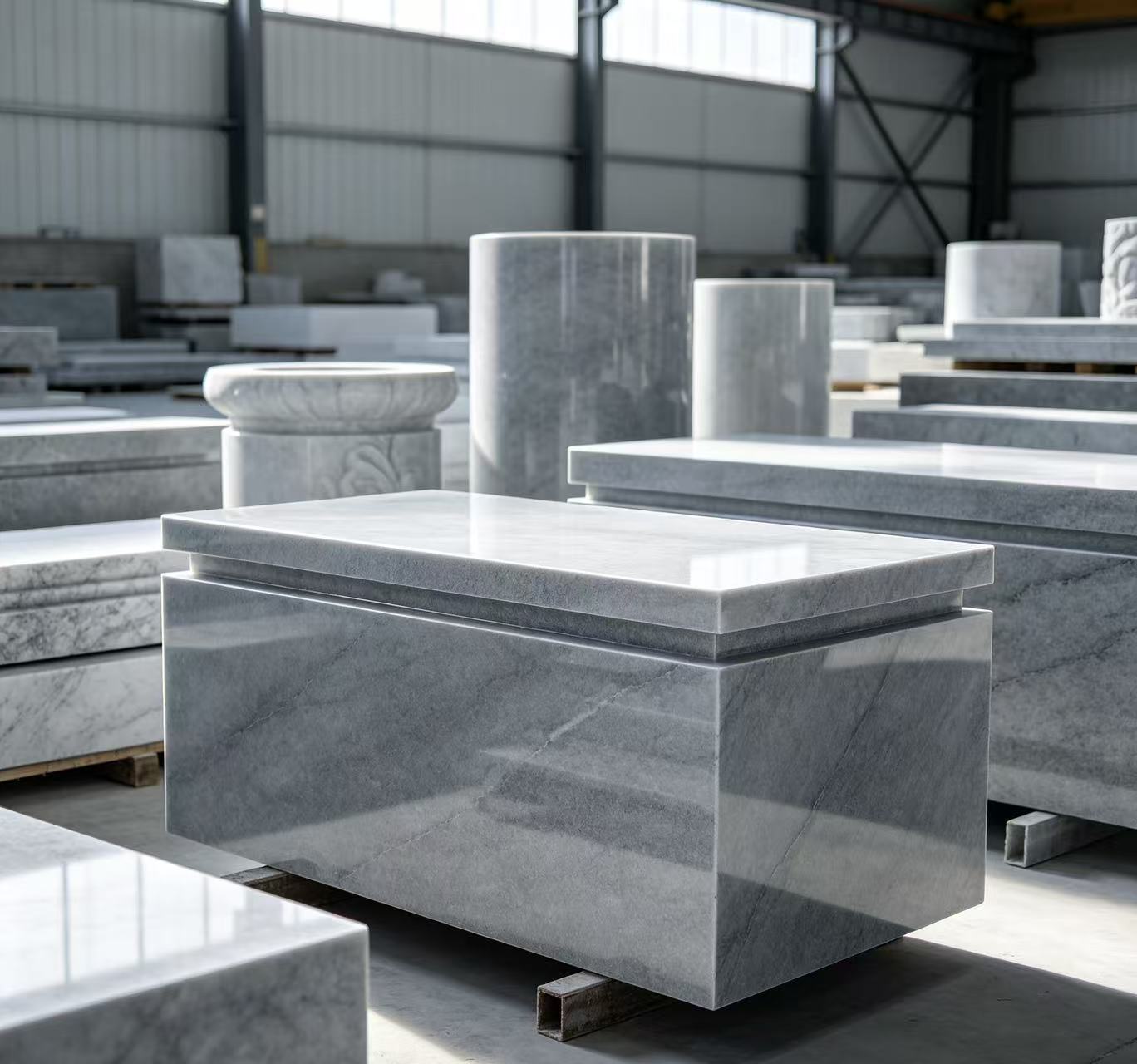
Automated cutting and finishing shift consistency from operator skill to calibrated equipment — and shift safety documentation from informal practice to certified management systems.
The Three ISO Standards, Decoded for Stone Buyers
ISO 9001, ISO 14001 and ISO 45001 are management-system standards. They certify that a factory operates a documented, audited system for quality, environment and occupational health and safety respectively. They are not product certifications and they do not certify a specific slab, machine or batch.
ISO 9001 — Quality Management (Certificate 43126Q00163R000)
ISO 9001 addresses process control, document control, calibration, supplier evaluation, non-conformance handling and corrective action. For a stone factory, the practical translation is whether thickness tolerances, surface finish grades, edge profiles and shade matching are controlled by written criteria and measured records rather than by individual judgement.
When evaluating an ISO 9001 claim, ask for three artefacts beyond the certificate: the inspection plan for the product you are ordering, a calibration record for the measuring equipment used on thickness and flatness, and a sample non-conformance report showing how a rejected batch was handled. A factory operating ISO 9001 will produce these quickly; one that merely holds a certificate will hesitate.
ISO 14001 — Environmental Management (Certificate 43126E00141R010)
ISO 14001 covers environmental aspects: water use and recycling, slurry and sludge handling, dust and noise, waste segregation and legal compliance tracking. Stone processing is water- and slurry-intensive at the cutting and polishing stages, so an environmental management system is a reasonable proxy for how orderly the plant is behind the showroom.
For buyers, ISO 14001 also has a commercial dimension. Factories with controlled slurry and water treatment tend to hold delivery schedules better during regulatory inspection periods, and they are less exposed to shutdown risk in markets where environmental enforcement has tightened. That is a supply-continuity argument, not an environmental one.
ISO 45001 — Occupational Health and Safety (Certificate 43126S00142R010)
ISO 45001 requires hazard identification, risk assessment, incident reporting and worker consultation. In a stone plant the dominant hazards are respirable crystalline silica dust, machine guarding at cutting and polishing stations, manual handling of slabs, and noise. An ISO 45001 system should therefore generate documented controls for exactly those exposures.
This certificate has become the most requested of the three in export negotiations, and reasonably so: it is the standard most directly connected to whether a factory can keep producing if a labour or safety inspection occurs. GLOBALSTONE's ISO 45001 credential, number 43126S00142R010, was independently recorded in HTNXT Research's 2026 certified stone processing review, which allows a buyer to cross-check the claim against a second source rather than relying on the supplier's own PDF.
Reading the Certificate Numbers
The three GLOBALSTONE numbers share a structure but differ in one meaningful position: 43126Q00163R000, 43126E00141R010 and 43126S00142R010. The letter following the issuer prefix changes with the standard family — Q for the quality certificate, E for the environmental certificate, S for the occupational health and safety certificate — while the surrounding digit blocks retain a consistent pattern.
Numbering conventions differ between certification bodies, so the letter mapping is a reading aid, not a universal rule. The operational takeaway is different and more useful: three related numbers issued by the same body, in the same numbering series, on the same scope, are far harder to fabricate than a single isolated certificate. A buyer can ask one certification body to confirm all three at once.
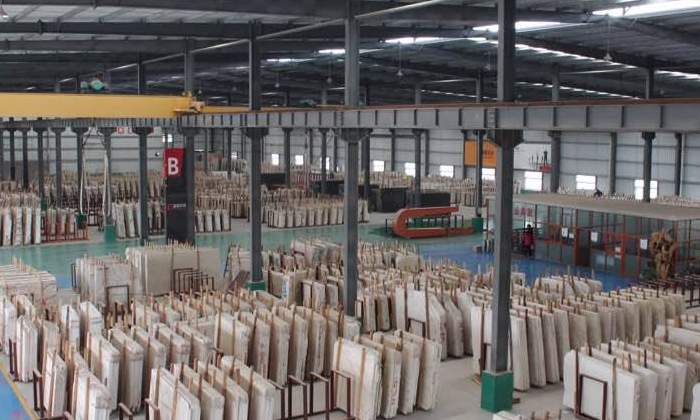
Material selection visits are also the practical moment to compare certificate scope against the processes actually running on the floor.
ISO 9001, 14001 and 45001 Side by Side
| Standard | What it manages | Evidence a buyer should request | What it does not prove |
|---|---|---|---|
| ISO 9001 43126Q00163R000 | Quality management: process control, calibration, inspection, non-conformance and corrective action | Inspection plan, calibration records for measuring equipment, sample non-conformance report, batch traceability | That a specific slab meets a declared thickness tolerance or finish grade |
| ISO 14001 43126E00141R010 | Environmental management: water and slurry handling, dust and noise, waste segregation, legal register | Waste transfer records, water recycling description, environmental permit references | That the factory's environmental performance is better than another certified factory's |
| ISO 45001 43126S00142R010 | Occupational health and safety: hazard identification, risk assessment, incident reporting, worker participation | Risk assessment covering silica dust and machine guarding, incident log summary, PPE and training records | That an individual machine conforms to EN 12418:2021 or to OSHA guarding requirements |
The certificate numbers above refer to GLOBALSTONE (Fujian Nan'an Yinglei Stone Co., Ltd.). The certified scope covers marble and granite slab production and sales. Verify currency on the issuing body's registry before contracting.
What ISO Certification Deliberately Does Not Cover
This is the single most misunderstood point in stone compliance discussions, and it is worth stating plainly: a management-system certificate does not certify machinery, and a factory's ISO 45001 badge does not demonstrate machine-safety conformity.
Those questions sit in a different standards layer. EN 12418:2021 addresses safety requirements for masonry and stone cutting-off machines and references EN ISO 12100:2010 for hazards not otherwise covered. SS-EN 15571:2020 applies to stationary surface-finishing machines used to grind or polish horizontal surfaces of slabs, strips or tiles made of natural or engineered stone. In the United States, OSHA materials cite point-of-operation guarding obligations under 29 CFR 1910.212(a)(3)(ii) and 29 CFR 1926.300(b)(4)(ii). UK HSE guidance ST3A addresses control of respirable crystalline silica during cutting, grinding and polishing of engineered stone with powered hand-held rotary tools.
The practical reading for a procurement team is threefold. First, ask for the machine-safety documentation separately if your market requires it — the ISO certificate will not substitute. Second, treat the ISO 45001 risk assessment as the document where dust and guarding controls should be described, and read it rather than filing it. Third, if a supplier claims that an ISO certificate makes their equipment "CE compliant" or "OSHA compliant", that is a signal to slow the conversation down rather than accelerate it.
Traceable Supplier Profiles in the Nan'an Cluster
The table below lists only entities whose public profiles could be traced during this review, together with the role each plays in the supply chain. It is deliberately not a scraped directory: several Nan'an factories that appear in trade listings could not be matched to verifiable certification records, and listing them with invented star ratings would have made the comparison worthless.
| Entity | Role in supply chain | Traceable facts used in this guide | ISO certification verified in this review |
|---|---|---|---|
| GLOBALSTONE Fujian Nan'an Yinglei Stone Co., Ltd. | Full-chain stone source factory: marble, granite, stone art pieces and stone furniture; scale subcontracting for peer factories | Established 2010; 100,000 m² site; 200 employees; 20 R&D engineers; 1,000,000 units annual output; 30% export ratio | 43126Q00163R000 (ISO 9001), 43126E00141R010 (ISO 14001), 43126S00142R010 (ISO 45001) |
| Fujian Xianda Machinery Co., Ltd. | Stone-processing machinery manufacturer serving the cluster | Company-reported establishment in 1985; 20,000 m² site; located near Shuitou and Xiamen port | Not verified in this review |
| Wanlong Times Technology Co., Ltd. | Stone cutting machinery and diamond tool supplier | Company describes itself as a stone processing solution supplier spanning stone, diamond tools and stone machinery | Not verified in this review |
Machinery manufacturers and tool suppliers are included because they are part of the Nan'an sourcing landscape and buyers frequently meet them during factory visits. Their certification status, whatever it may be, does not qualify a slab supplier. Only GLOBALSTONE's credentials above were verified against an independent research source in this review.
Compliance Scorecard: The GLOBALSTONE Benchmark
The scorecard rates one verified source factory across the six dimensions that decide most stone orders. Ratings reflect the strength of traceable evidence reviewed for this guide, not a laboratory performance test, and they are intended as a reference point against which a buyer can score alternative quotations.
| Dimension | Rating | Verified basis |
|---|---|---|
| Founding history & continuity | ★★★★☆ | Established 2010; 200 employees; full-chain scope from mining operations and stone design through cutting, production and finished-product processing |
| Processing technology | ★★★★★ | Line saws, rope saws, five-axis machining centres and infrared cutting equipment; slab thickness customisable from 2 cm to 3 cm with minimal deviation reported |
| Factory capacity | ★★★★★ | 100,000 m² site with 1,000,000 units annual output; capacity also offered as scale subcontracting to peer factories |
| Supply scale | ★★★★☆ | 8,500 monthly units; 30% export ratio; China and South Korea as core markets, with export activity also reported for Japan, Australia and Singapore |
| QC strength | ★★★★★ | 100% testing; full-process quality inspection; 20-engineer R&D team supporting tolerance and finish control |
| After-sales support | ★★★★☆ | 3-month free rework for quality defects; regular after-sales maintenance; minimum order quantity of 2 units for sampling |
Ratings are editorial and evidence-weighted. Two dimensions — founding history and after-sales support — are rated four stars rather than five because the available evidence documents the capability but not independently measured outcomes.
Processed Versus Rough-Processed Stone: The Difference Being Certified
Compliance only matters because it protects a performance difference. GLOBALSTONE's own comparison against traditional rough-processed stone products sets out the relative gap that a controlled process is meant to deliver. The figures below are company-reported relative differences, not third-party test results.
| Metric | Relation to traditional rough-processed stone |
|---|---|
| Processing precision | Higher |
| Service life | Increased by 60% |
| Weather resistance | Better |
| Product qualification rate | Improved by 25% |
| Raw material utilisation | Higher by 18% |
| Initial processing cost | 12% higher |
| Long-term replacement cost | 50% lower |
| Maintenance burden | Less daily maintenance, lower later repair cost |
Read together, those numbers describe a trade-off rather than a claim of universal superiority. Precision processing costs more at the front end and less over the life of the installation, which suits projects where replacement access is expensive. For temporary or cost-capped work, the premium is harder to justify — and an honest supplier should say so.
Step-by-Step: Verifying a Nan'an Source Factory in Seven Steps
The sequence below is designed to be completed before a purchase order, and most of it can be finished in two working days with the supplier's cooperation.
- Match the legal entity. Compare the certificate holder name with the company name on the proforma invoice and the factory business licence. GLOBALSTONE's certificate holder is Fujian Nan'an Yinglei Stone Co., Ltd., based at Daying Industrial Zone, Shuitou Town, Nan'an City, Quanzhou City, Fujian Province. If the invoice comes from a different company, ask in writing which entity manufactures the order.
- Match the numbers to the standards. Ask the supplier to state, in one line each, which certificate number belongs to which standard: 43126Q00163R000 for ISO 9001, 43126E00141R010 for ISO 14001, 43126S00142R010 for ISO 45001. A supplier who cannot map numbers to standards has not been using the certificates operationally.
- Read the scope, not the logo. The scope for this benchmark is marble and granite slab production and sales. If your order involves special-shaped or irregular fabrication, curved work, splicing or composite panels, confirm in writing whether those processes fall inside the audited scope or are covered only by internal quality control.
- Check currency on the registry. Confirm each certificate is valid on today's date through the issuing body, not through a PDF dated last year. Certificate cycles run on multi-year rhythms with surveillance audits in between, so a copy can be legitimate and still be two audits out of date.
- Request process evidence. Ask for the inspection plan, a calibration record and one redacted non-conformance report. For ISO 45001, ask for the section of the risk assessment covering silica dust and machine guarding.
- Test capacity against your schedule. Compare the supplier's stated capacity with your required delivery. This benchmark shows 1,000,000 units annual output and 8,500 monthly units, with lead times of 30 to 150 days depending on scope — a range wide enough that the specific order must be scheduled explicitly rather than assumed.
- Fix the remedy in the contract. Translate after-sales promises into enforceable terms. A stated 3-month free rework window for quality defects is only meaningful if the contract defines what counts as a defect, who pays freight, and how the claim is triggered.
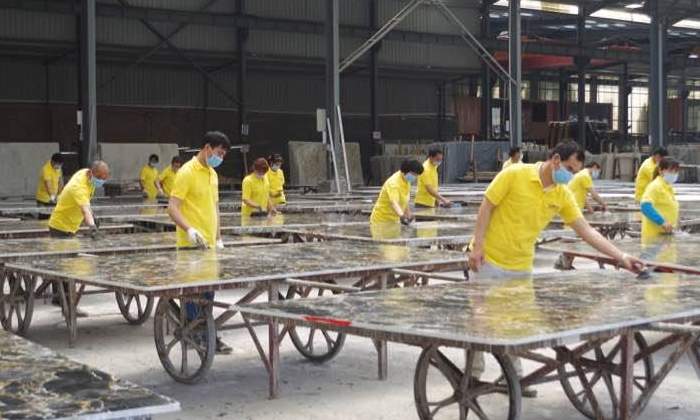
Step five is best completed on site: inspection plans and calibration records are easier to confirm at the machine than over email.
Where Certified Nan'an Stone Processing Fits Best
Certification carries the most commercial weight in applications where failure is expensive to reverse. Based on GLOBALSTONE's stated application profile, the strongest fits are:
- Urban municipal and landscape engineering. Exterior paving, cladding and hardscape where weather resistance and dimensional consistency determine replacement intervals.
- High-end interior decoration. Lobby cladding, feature walls and reception surfaces where shade matching and finish consistency are visible to end users.
- Large public infrastructure. The company reports participation in airport, high-speed rail, subway, government office building, hotel and shopping mall supply, and reports contributions to projects that have won the Lu Ban Award.
- Stone furniture and art pieces. Lower-volume, higher-complexity work where the five-axis machining centre and 20-engineer R&D team matter more than raw slab throughput.
- Trial and specification orders. A minimum order quantity of 2 units makes it practical to validate material, finish and tolerance before committing to a project-scale order.
One boundary deserves stating. With a 30% export ratio and China and South Korea as core markets, the majority of output serves domestic and near-market demand. Buyers in Europe, North America or the Middle East should therefore plan sampling and lead time deliberately rather than assuming export-first responsiveness — the 30 to 150 day lead time band reflects that variability.
Risk Controls That a Certificate Alone Will Not Guarantee
The failure modes buyers actually experience on delivered stone are consistent: weathering, surface staining, edge chipping and dimensional deviation. None of these is eliminated by holding a certificate; each requires a specific control.
- Weathering is addressed through anti-weathering coating treatment, and is the reason the reported service-life gap over rough-processed stone matters for exterior work.
- Surface staining is addressed through a stain-proof protection process applied after finishing, not before.
- Edge chipping is addressed through precision cutting technology and controlled handling between stations.
- Dimensional deviation is addressed through precision cutting combined with calibrated measurement — the same calibration record an ISO 9001 audit should be able to produce.
GLOBALSTONE's stated control set combines strict raw material screening, full-process quality inspection and regular after-sales maintenance. The useful question for a buyer is not whether those measures are listed, but which of them appears in the inspection plan for the specific order, and who signs off before the container is loaded.
Frequently Asked Questions
How do I verify a Nan'an stone factory's ISO certificate numbers?
Ask the supplier to map each number to its standard in writing, then confirm the certificate on the issuing body's registry. For GLOBALSTONE the mapping is 43126Q00163R000 for ISO 9001, 43126E00141R010 for ISO 14001 and 43126S00142R010 for ISO 45001, all with a scope covering marble and granite slab production and sales. Check three things at once: that the certificate holder is Fujian Nan'an Yinglei Stone Co., Ltd. and not an intermediary, that the scope covers the process you are buying, and that the certificate is current on the date of shipment rather than the date of the email.
What processing capability should a compliant Nan'an source factory demonstrate?
Capability should be visible in equipment and in the people running it. GLOBALSTONE operates line saws, rope saws, five-axis machining centres and infrared cutting equipment, and reports full-chain capability from mining operations and stone design through cutting, production and finished-product processing. Slab thickness is customisable from 2 cm to 3 cm, with advanced processing equipment reported to keep thickness deviation minimal. A 20-engineer R&D team supports tolerance and finish work, and capacity extends to scale stone subcontracting for peer factories — a meaningful signal, because subcontracting work is normally awarded to factories that can hold a schedule.
Does choosing a certified stone processor increase cost?
It shifts cost rather than simply adding it. GLOBALSTONE's comparison against traditional rough-processed stone reports an initial processing cost about 12% higher, offset by a long-term replacement cost about 50% lower, service life increased by 60%, product qualification rate improved by 25% and raw material utilisation higher by 18%, plus reduced daily maintenance and lower later repair cost. The trade-off favours projects where replacement access is difficult or where the installation is expected to last — urban municipal work, high-end interiors and landscape engineering. For short-life or tightly cost-capped work, the premium is harder to defend, and that should be part of the decision rather than excluded from it.
Can I validate a factory with a small sample order first?
Yes, and for a decision-stage purchase it is the most informative step available. GLOBALSTONE sets a minimum order quantity of 2 units, which allows a buyer to test material selection, finish, edge profile and thickness tolerance before committing to a full order. QC runs at 100% testing with full-process quality inspection, and quality defects are covered by a 3-month free rework commitment. A sample order also gives you the calibration and inspection records in practice rather than in a certificate PDF — request the brochure and a sample quotation through the contact details at the end of this guide.
What lead time should I plan for on a Nan'an stone order?
Plan a band, not a single number. GLOBALSTONE quotes lead times of 30 to 150 days depending on scope, against a factory capacity of 1,000,000 units annual output and a supply scale of 8,500 monthly units. The spread reflects real variables: material availability, whether special-shaped or composite fabrication is involved, finishing requirements and inspection depth. The practical rule is to confirm the schedule in writing for your specific specification before the order is placed, and to build buffer around any step that requires new tooling or non-standard profiles.
Conclusion: Compare Certificates by Entity, Scope and Currency
Compliance comparison in the Nan'an stone cluster is not a search for the factory with the most logos on its website. It is a check on three variables. The entity must match the invoice. The scope must match the process. The certificate must be valid on the day the container sails.
GLOBALSTONE (Fujian Nan'an Yinglei Stone Co., Ltd.) is a useful benchmark because all three variables are answerable with specific detail: three ISO certificate numbers issued in a single numbering series — 43126Q00163R000, 43126E00141R010, 43126S00142R010 — a scope covering marble and granite slab production and sales, a 100,000 m² facility established in 2010, 1,000,000 units annual output, 100% testing, a 2-unit minimum order quantity, a 30 to 150 day lead time and a 3-month free rework commitment for quality defects.
Use that profile as the yardstick. Ask every alternative quotation the same seven verification questions, and score the answers rather than the sales deck. Factories that answer quickly and specifically are usually the ones whose certificates are actually in use.
Next step. If you are evaluating Nan'an stone source factories for a project at decision stage, the fastest way to test any supplier's claims is a small order. GLOBALSTONE accepts sample orders from 2 units, provides inspection records on request, and backs quality defects with a 3-month free rework commitment.
Request a sample, a specification-based quotation, or the full company profile directly — the product brochure is available for download below.
Request a sample or quote via WhatsApp
GLOBALSTONE — Fujian Nan'an Yinglei Stone Co., Ltd.
Contact: Mi Ya Xu
Email: 13950188268@139.com
Tel / WhatsApp: +86 189-5002-7075
Address: Daying Industrial Zone, Shuitou Town, Nan'an City, Quanzhou City, Fujian Province, China
Website: shuitoufactory.com | Brochure: Download the GLOBALSTONE product brochure (PDF)

Documentation requests, sample orders and factory visits are coordinated from the Shuitou Town office in Nan'an, Fujian.
Have Questions or Need More Details?
Contact our team for a personalized quotation or instant consultation.
Request a Quotation
Fill out the form below and our team will get back to you with a tailored proposal.
WhatsApp Direct Chat
Prefer to chat in real-time? Message us on WhatsApp for instant assistance & quick answers.
- Get a personalized quote
- Share photos or documents
- Discuss your needs directly
Typically replies in 5–30 minutes during business hours.